
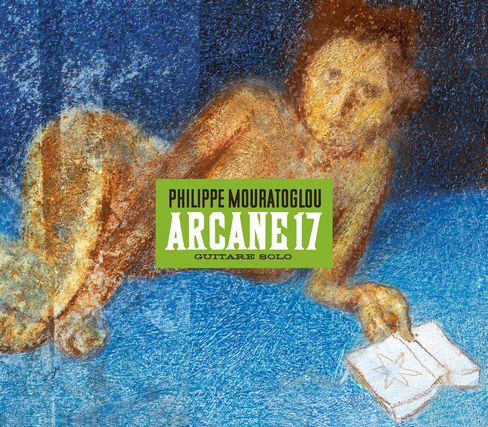
A disciple of Wim Hooggewerf, Roland Dyens, and Pablo Márquez (whose assistant he was at the Strasbourg Conservatory), Philippe Mouratoglou had all the skills, and the legitimacy, to become a conventional classical guitarist. But that wasn't accounting for an open-mindedness and wide-ranging curiosity that led him, alone or with various small ensembles, to explore the most diverse genres and to play steel-string, six-string, twelve-string, and baritone guitars.
At the same time, in 2012 Philippe Mouratoglou founded the label Vision Fugitive together with clarinetist Jean-Marc Foltz and graphic designer Philippe Ghielmetti, on which he has pursued a string of original projects: after an exploration of bluesman Robert Johnson's repertoire (Steady Rollin' Man, 2012), a guitar-double bass-drums trio with Bruno Chevillon and Ramón López (Univers-solitude, 2018; Ricercare, 2021; Nautiles, 2025), and two particularly adventurous recitals in which Francesco da Milano converses with Benjamin Britten and with his own improvisations (Exercices d'évasion, 2013; D'autres vallées, 2016), Philippe Mouratoglou also rose masterfully to the challenge of breathing new life into the most well-trodden repertoire of romantic guitar, that of Fernando Sor (2019).
After La Bellezza, a journey through five centuries of lute and guitar music that drew critical acclaim, his new odyssey leads him through the most refined byways of a modern repertoire, from the twentieth century to today. Contemporaries who have become classics (Manuel de Falla, Frank Martin, Leo Brouwer, Toru Takemitsu) sit alongside Philippe Mouratoglou's own improvisations — so many "explosantes-fixes" (fixed-explosions) sketched out under the benevolent sign of a tarot card dear to the surrealist André Breton.
Philippe Mouratoglou : nylon string guitar, steel-string guitar
ARCANA 17: TO THE SEALED STAR
In a time when the aesthetic distinctions between art music and popular music, between the written and the oral, seem to dissipate while continuing to shape the commercial policies of major record companies, Philippe Mouratoglou stubbornly persists in ignoring these classifications that only satisfy the fans of pigeonholing and the marketing of "cultural products".
Ever faithful to the eclecticism that already marked his two previous solo projects — Exercices d’évasion in 2013 and D’autres vallées in 2016 — as a true Spinozist musician he "strives to persevere in his being" with this new album, which juxtaposes set pieces from the repertoire and improvisation, nylon and steel-string guitars, rigor and fantasy. If he continues to define himself as a "classical guitarist", it is in the best sense of the word classical, which means nothing more than yesterday's modernity projected onto a possible future.
As such, he firmly follows a tradition that entwines with the history of the guitar: that of the performer-composer. This tradition has flourished to the point that it almost entirely overlays the instrument's vast repertoire, particularly during the 19th century when Fernando Sor, Mauro Giuliani, Giulio Regondi, Ferdinando Carulli and so many others established the bases of a written repertoire that is still studied today, while garnering recognition as first-rate concert performers. Despite attracting composers who did not necessarily play the instrument (as is the case for Swiss composer Frank Martin, who is present on this album), the 20th century saw the continuation of this tradition through the likes of Agustín Barrios Mangoré and Roland Dyens, not to mention Leo Brouwer, and Philippe Mouratoglou, whose talents for composition and improvisation nourish his skills as a performer.
Arcane 17, which takes its title both from the seventeenth arcana of the Tarot, that of the stars that preside over vital impetus and creativity, and from what is certainly the densest book by André Breton, is not one of those "concept albums" that young performers lacking imagination throw at us to draw what they believe are new links between set pieces of the repertoire that have been visited hundreds of times: rather it is a sort of homage to homage itself, or a diffracted or redoubled homage to a history of music that can only be written in the future perfect.
The first to be featured on this album, Cuban guitarist-composer Leo Brouwer (born in 1939) is without doubt the most important figure of the classical guitar repertoire in the second half of the 20th century. There are several good reasons for this: an outstanding and unique performer — his style seems to have developed from his Caribbean roots, sheltered from Western influences, in the footsteps of the Haitian Frantz Casseus or another little-known Cuban, the great Ñico Rojas — Brouwer has never considered it useful, or even convenient, to choose sides. He has composed flawless adaptations of Beatles songs for guitar, while writing atonal pieces, as well as showing the paradoxical courage to develop one of the most arid aesthetics, or "formalist" as it was called in countries within the Soviet sphere, while becoming, without demonstrating much resistance, the emblem of Castro's cultural politics. The album opens with a very pure concentrate of his style, Preludio epigramático No. 1: from an ostinato figure of a broken third rises a desolate melody whose barbed ornaments evoke the stridulations of nature that enchant the nights in the Cuban countryside. The El Decamerón negro cycle, dating from the same period, tends towards a more European modernity, while retaining its idiomatic roots in the fantastic realism that was of such great importance in all forms of South American art.
Between these two milestones, Philippe Mouratoglou inserts three of his own works, played on steel-string guitar with open tunings that favor lower frequencies: No te asomes, Escribí en el arenal, and Llegó con tres heridas. All are commentaries/tributes to three poems by Miguel Hernández, a friend of Federico García Lorca and a committed Republican during the Spanish Civil War who became a martyr for the cause through his early death in 1942. His poems, some of which have been set to music by Paco Ibáñez, stand out for their starkness, their haiku-like sobriety and their muted tragedy. There is almost as much silence as there are words in this expression, and this eloquent silence is reflected in Philippe Mouratoglou's musical meditations, as if suspended in time and space.
The next cycle was not penned by a guitarist: Quatre pièces brèves by Frank Martin (1890-1974) is nonetheless one of the major landmarks in 20th century guitar music. Composed in 1933 at the initiative of Andrés Segovia, these four pieces, which make non-dogmatic and after all rather melodic use of unconstrained dodecaphony, were not well received by the great but testy Spanish guitarist, who, if we are to believe the legend, did not even bother to acknowledge their receipt. It is true that this type of misadventure befell more than one contemporary solicited by Segovia; alone to receive his recognition were those who acquiesced to his interventionism and constant rewritings, as if to transform a painting by Picasso into a pale allegory by Puvis de Chavannes...
Frank Martin was disconcerted and undoubtedly disappointed, but did not concede defeat and very skillfully transcribed these pieces for piano, thus ensuring their posterity. It must be said that this music is both familiar and surprising. It borrows rhythmic patterns from Baroque and Classical music (e.g., the gigue) with a harmonic vocabulary that, while hardy, never loses sight of the melodic horizon. It bears something of a modernist archaism, a little like the marvelous miniatures by his Catalan contemporary, Federico Mompou.
It would be flippant to mention the secret relationships between tradition and modernity without paying tribute to Heitor Villa-Lobos (1887-1959), represented here by his Preludes No. 3 and No. 4 and Etudes No. 7 and No. 12. Never, undoubtedly, has a composer embodied such a mix of chthonic strength and extreme refinement of composition. There was something of the ogre in this proud Brazilian, which is hardly surprising coming from a country where the avant-garde of the 1920s labeled itself "anthropophagic", to designate the way in which art must devour all influences, indigenous and colonial alike, in order to create a new form of artful savagery. Entirely self-taught in his beginnings, playing music in hiding from a family that had hopes of a more suitable future for him, Villa-Lobos was an undisciplined and runaway teenager, always on the lookout for street music (modinhas and choros) and then, pushing ever forward, traditional songs from Amazonia. Although his knowledge of the cello afforded him a technical grounding in academic music, the guitar nevertheless remained his preferred instrument throughout his life, the instrument he would hide under his bed, a treasure that was inaccessible to his parents' desire for conformity. He thus wrote, among an enormous body of around 1300 works, some of the instrument's finest pages, including those presented in this album. However, "Prelude" and "Etude" do not hold the same meaning for Villa-Lobos as they do for Chopin or Scriabin: his preludes present, in a short form, technical challenges that do not necessarily appear in the etudes, which traditionally have a more pedagogical purpose. For Villa-Lobos, everything is equally and enormously musical. Everything flows like an imperious river and the many difficulties of fingering dissolve (as is often the case for Liszt) into the ergonomics of the musical gesture: in his works for guitar, the left hand often explores all the possibilities of a single chord shape transposed over the entire length of the neck. This approach is instinctive, purely malleable, and constantly seeks unprecedented harmonic tension. Villa-Lobos was a larger-than-life figure without whom the history of the guitar would have been terribly depleted.
At the time when Villa-Lobos was leading his passionate search for the vernacular music of Amazonia, other musicians, in North America, were unwittingly inventing the future of all the popular music we know today. A program such as this, which intends to pay homage to all facets of the guitar, could not ignore the pioneers of the blues, which today remains the lingua franca of all aspiring jazz and rock guitarists. Although Robert Johnson remains the figurehead among bluesmen, it is nonetheless another pioneer who dominates in the shadow of this tellurian music that has never turned its back on its African roots: Blind Willie Johnson. Neither the hardships of a tragic life nor the brevity of his recorded heritage could prevent his posterity from flourishing. Although he probably did not invent slide guitar (the technique that consists of sliding a metal or glass tube or knife blade up and down the strings to produce a glissando effect), he was nevertheless its most impressive representative, inventing notes between the notes that accompanied his cavernous preacher's voice. Philippe Mouratoglou's homage, in his short Tombeau de Blind Willie Johnson, captures the abstract spirit of this abrasive art form. There are no blues scales or pentatonic licks here, only the spectral evocation of a shadow, like a diffracted memory or a portrait in invisible ink.
If Tōru Takemitsu (1930-1996) and Leo Brouwer have a single point in common, it is their shared passion for the Beatles which led them to transcribe some of the group's most famous songs for solo guitar. Except that Takemitsu did so several years before Brouwer (even if the true pioneer in the matter remains Luciano Berio, who produced highly sophisticated arrangements of several Beatles songs as early as 1967). In 1974, several years before his Twelve Songs for Guitar, Takemitsu authored three short pieces for guitar, the Folios, which have since established themselves as classics in the instrument's contemporary repertoire. Ever the victim in the West of an ambiguous "orientalism", the works of Takemitsu, through their profound originality, easily transcend geographical labels and cultural differences. As such, they more than ever merit reassessment. However, his harmonic language, deeply steeped in Debussy and Messiaen, never ceased to evolve toward an increasingly personal idiom. The Folios are like a miniature concentrate of his constant preoccupation with a certain form of silence on which harmonic aggregates alight like birds on a wire. Folio 3 ends on a surprising literal citation of the "O Haupt voll Blut und Wunden" chorale from Johann Sebastian Bach's St. Matthew Passion, a moving way of "going back to the source" for this artist who was so sensitive to nature that his art can rightly be considered a form of musical pantheism.
Jisei and Poème suspendu by Philippe Mouratoglou, which follow the Folios, come as an aerial codicil, like the Ukiyo-e, "images of a floating world" so dear to the masters of Japanese prints. In them we find the same sure hand serving an eloquent silence; something like the musical translation of a kōan, one of those logic-defying enigmas that Zen masters give their disciples to meditate on.
It is difficult to imagine a more marked contrast than with Percussion Study No. 1 by Brazilian-born Arthur Kampela (born in 1960). Classified a little lazily among the ranks of the "new complexity" movement — no doubt due to his objective acquaintances with the works of Brian Ferneyhough — Kampela is a much more versatile composer, capable of deconstructing Brazilian popular music while elaborating a complex system of "micro-metric modulation".
His Percussion Studies demonstrate an almost exclusively percussive use of the guitar, multiplying the technical challenges that force the performer into an engagement of the entire body that the so-called "academic" position of the guitarist does not permit. Of course, there is nothing new here, as Hans Werner Henze and Leo Brouwer already explored this vein in Memorias de El Cimarrón (1970).
Yet, by systematizing the process, Percussion Study No. 1 is a work to both see and hear, inasmuch as its harshness and stridencies push the limits of what we believed technically possible on the guitar.
Had Edgard Varèse written for the instrument, it certainly would have resulted in something similar.
In 1920, Henry Prunières, director of the important Revue Musicale, had the idea of soliciting some of the most prominent composers of the time to write a collective tribute to the memory of Claude Debussy, who had died two years before. In this Tombeau de Claude Debussy, which brings together ten short pieces penned by, among others, Erik Satie, Paul Dukas, Albert Roussel and Igor Stravinsky, two major works nevertheless stand out: Duo by Maurice Ravel, which would become the first movement of his Sonata for Violin and Cello, and Homenaje by Manuel de Falla. Even though he was recognized during his lifetime as the most eminent figure in Spanish music, Manuel de Falla only wrote a single work for guitar, precisely this Homenaje — which certain sources affirm he completed with the help of guitarist Miguel Llobet, in the family home of the García Lorcas in Granada. Indeed, the score is so scrupulously detailed (nearly every note bears an indication of nuance or attack) that we unfailingly sense the presence of the hand of a master guitarist. This extremely dense masterpiece manages to combine a desolate chromatic melody, in keeping with the idea of a threnody associated with the Tombeau, with a lascivious habanera rhythm whose obsessive pulsation is only marked here and there by fast quintuplet arpeggios. Perhaps music has never so well expressed the celebration of life that, not so paradoxically, constitutes any posthumous tribute if it is sincere. And here, Manuel de Falla sincerely celebrates the memory of Debussy.
This luminous but never lugubrious work rejoins the vital impetus that survives the disappearance of loved ones, when the memory, far from darkening our recollections, is akin to this Étoile [Star] that brings this program to a close through a short meditation by Philippe Mouratoglou.
This Star illuminates our lives that flow like the water poured from the jars by the woman depicted in majesty in the mysterious Arcana 17 of the Tarot.
GILLES TORDJMAN